

The media, healthcare professionals, supermarket chains… constantly remind us of the importance of consuming five servings of fruit or vegetables a day. Why is it so important? Why five? What exactly constitutes a serving when we talk about fruits and vegetables?
Often, we don't eat well because we don't know how. That's why today we're answering all these questions and giving you some tips for incorporating fruits and vegetables into your diet. Not only will you be taking care of your health, but you'll also be supporting the consumption of fresh produce and, if you shop responsibly, locally sourced products.
Why five a day?
Several scientific studies support the idea that consuming five servings of fruits and vegetables a day helps prevent certain types of cancer, provides essential nutrients, and is associated with a lower risk of mortality. Furthermore, they help combat conditions such as obesity, hypertension, and metabolic syndrome.
This evidence led to the start of this movement that promotes the consumption of fruits and vegetables. The first country to implement it was the United States in the late 1980s. But it soon spread throughout the world.
The entities in each country that supported this message joined together in an international alliance, the Global Alliance for the Promotion of Fruit and Vegetable Consumption “5 a Day” (AIAM5), which promotes health and the consumption of fruit and vegetables.
In Spain, this campaign was first launched in 1998 and was primarily aimed at children. Since then, numerous initiatives have been carried out in our country. That's why we have internalized the 'five a day' message so much.
How much is a serving?
To simplify the message, we can say that it's healthy to eat five servings of fruits and vegetables a day. However, we know that for some fruits, a single serving isn't enough, as with strawberries or cherries; or it's too much, as with pineapple. So, to make it easier, the '5 a Day' campaign estimates that a serving ranges from 150 to 250 grams of produce. Depending on what you plan to eat, you can calculate the serving size by unit or by weight.
In the next link You have some examples of standard quantities. Because in this matter, as in all others, common sense must be applied, and it's important to understand that these recommendations are guidelines only.
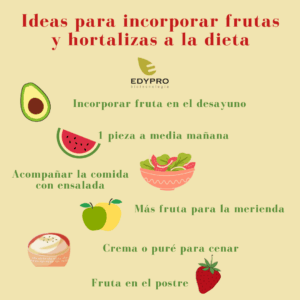
How do I incorporate it into my diet?
If we stop to think about it, it's much simpler than we think. Thankfully, this is a minimum recommendation, because if we include a piece or serving in every meal of the day, we'll be overdoing it.
Our suggestion is just a simple, practical example. Everyone should incorporate it into their diet taking into account their lifestyle, health factors, and preferences.