


As every year on January 17th, this Sunday marks the feast day of Saint Anthony the Abbot. This saint is the patron saint of domestic animals, as it is said that he defended and protected them throughout his life. For EDYPRO, this date holds great significance, as this celebration is deeply rooted in Valencia, and our technical director has actively participated as a speaker for over 15 years in the blessing of animals organized by the Brotherhood of Saint Anthony the Abbot on Sagunto Street. Furthermore, since 1988, he has collaborated in organizing the same festivities in his hometown of Foios.
This year, due to the health crisis, the celebration has been suspended and the animal parade will be held virtually. At EDYPRO, we want to join in the festivities and pay a humble tribute to domestic animals by analyzing the importance they have had, and continue to have, for agriculture.
The development and expansion of agriculture have been key to human survival and have conditioned its evolution and dispersal. It seems that animals began to be used in agriculture in the villages of Mesopotamia and Egypt around 10,000 BC. This fact represented a true revolution, as it facilitated and expedited work in the fields. “The energy supplied to the production process by domesticated animals (cattle, donkeys, camels, and later, mules and horses), which in pulling carts and plows can produce between 500 and 700 W of power instead of the 75 W of humans, constituted an advance comparable only to that obtained millennia later by fossil fuels” (Álvaro Martínez Álvarez, “Agriculture: from the Neolithic to Robotization”).
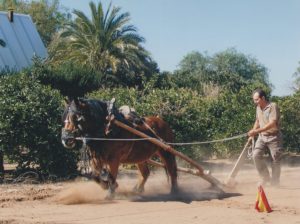
The prominent role of animals in agricultural work remained virtually unchanged for centuries. Their use in farming has helped to alleviate the workload on people, facilitated and expedited transportation, and improved working conditions and profit margins.
The participation of animals in these tasks has direct results on food production. Thanks to the energy they provide during sowing, plowing, hilling, and weeding, more and better crops can be produced. Furthermore, they also play a vital role in transporting people, materials, and harvests, and in other food processing activities, such as grain milling.
Animals: allies of sustainable agriculture
The industrial revolution and the introduction of agricultural machinery have gradually displaced animals from fieldwork. Even so, in less developed countries and societies, they remain crucial to agricultural work. The FAO points out that “400 million animals are involved in supplying energy to agriculture through plowing and transport.”.
It seems unthinkable that in the 21st century such a heavy reliance on animal power for agricultural development still exists, but the truth is that it's a solution available to almost every society, one that can achieve what technology cannot. In fact, in the current context of climate crisis, where there is also a push for a more rational use of resources and responsible agricultural management, the use of animals appears to be a rather efficient and accessible solution for sustainable organic farming.


1 Comment
Zidane
June 28, 2023, at 3:39 amThank you for the article.